


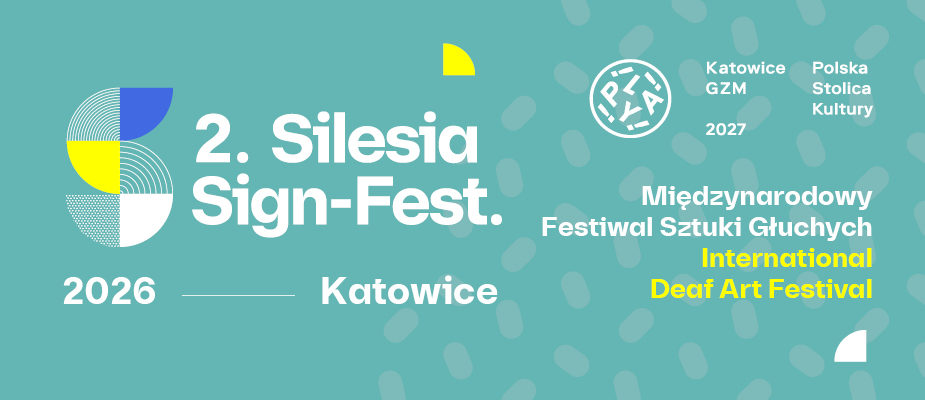
Silesia Sign-Fest – Festiwal Sztuki Głuchych 2026
„Silesia Sign-Fest – Festiwal Sztuki Głuchych” został zorganizowany po raz pierwszy w 2025 roku przez Katowice Miasto Ogrodów. W programie znalazły się wykłady, wystawy, warsztaty oraz pokazy filmowe. Wszystkie wydarzenia były tłumaczone na polski język foniczny.
English version below
Celem festiwalu jest szerzenie wiedzy i informacji o bogatej kulturze Głuchych oraz promowanie jej zarówno w środowisku osób g/Głuchych, jak i słyszących.
W 2026 roku Festiwal po raz pierwszy zyska międzynarodowy charakter. Wszystkie wydarzenia będą tłumaczone na polski język foniczny, PJM (Polski Język Migowy) oraz IS (International Sign).
Tegoroczna edycja odbędzie się 20 i 21 listopada 2026 roku.
W październiku ogłosimy szczegółowy program Festiwalu, w którym znajdziecie wykłady, wystawy, warsztaty oraz film.
„Silesia Sign-Fest” to pierwszy w Polsce festiwal poświęcony kulturze i sztuce Głuchych. W tym roku odbędzie się jego druga edycja. Inspiracją do stworzenia wydarzenia były moje doświadczenia z festiwali kultury Głuchych w Anglii i we Francji. Zobaczyłam tam, jak ważne są regularne spotkania, możliwość rozwoju artystycznego oraz budowanie wspólnoty osób g/Głuchych i słyszących.
W Polsce wciąż brakuje wydarzeń poświęconych kulturze Głuchych, a poziom wiedzy na temat języka migowego i doświadczeń społeczności g/Głuchych nadal jest niewystarczający. Dlatego celem festiwalu jest szerzenie wiedzy o kulturze Głuchych, przełamywanie barier komunikacyjnych oraz tworzenie przestrzeni do spotkania dwóch światów – osób g/Głuchych
i słyszących.
Podczas festiwalu odbędą się wykłady, warsztaty, dyskusje, wystawy, pokazy filmowe oraz spotkania z artystami. Ważnym elementem wydarzenia będzie również możliwość poznania osób Głuchych z innych krajów i wymiana doświadczeń międzynarodowych. Festiwal ma pokazywać różnorodność sztuki Głuchych oraz to, że sztuka i komunikacja nie mają granic.
„Silesia Sign-Fest” to także miejsce otwartości, wsparcia i integracji. Chcemy stworzyć przestrzeń, w której każdy będzie mógł poczuć się bezpiecznie, rozwijać swoje zainteresowania oraz budować wzajemne zrozumienie poprzez kulturę i sztukę.
Jak wyglądała pierwsza edycja Festiwalu? W przestrzeniach Miasta Ogrodów spotkali się uczestnicy g/Głusi i słyszący, aby wspólnie odkrywać sztukę oraz przełamywać bariery komunikacyjne. Ważnym wydarzeniem Silesia Sign-Fest był wernisaż wystawy „Sztuka Głuchych”, prezentującej malarstwo, fotografię, grafikę, modę, film i animację autorstwa artystów Głuchych.
Wystawa ukazywała kreatywność, różnorodność talentów oraz tematy związane
z audyzmem, komunikacją i tożsamością osób g/Głuchych. Festiwal obejmował także wykłady, warsztaty i projekcje filmowe, a uczestnicy podkreślali jego inspirujący
i potrzebny charakter, wyrażając nadzieję na kolejną edycję wydarzenia.
Tegoroczna, druga edycja Festiwalu, będzie jednocześnie pierwszą edycją międzynarodową.
Nowym i ważnym wyzwaniem jest dla mnie rozwijanie festiwalu w kierunku międzynarodowym. Chcę, aby Silesia Sign-Fest stał się miejscem spotkań osób g/Głuchych i słyszących z różnych krajów oraz środowisk artystycznych. Inspiracją są dla mnie doświadczenia zdobyte w Anglii i we Francji, które przenoszę na działania
w Polsce i na festiwalu.
Zależy mi na pokazaniu, że sztuka nie zna granic, a różnorodność perspektyw twórczych wzbogaca dialog międzykulturowy. Ważną rolę odgrywa tu International Sign (IS), który ułatwia komunikację i wymianę doświadczeń między osobami z różnych krajów.
Wierzę, że międzynarodowy charakter festiwalu pozwoli nie tylko prezentować sztukę Głuchych, ale także budować współpracę, inspirować i tworzyć przestrzeń wspólnego dialogu artystycznego."
Koordynatorka Programowa - Kinga Hołda-Justycka
Kultura Głuchych
Co to jest Kultura Głuchych? Czy podobnie jak kultura śląska różni się od kultury większości Polaków? Historia Ślązaków czy innych mniejszości językowo-kulturowych pozwala zrozumieć złożoność relacji społecznych. Podobnie jest w wypadku osób niesłyszących, dla których naturalnym językiem jest polski język migowy. Język migowy określa tożsamość, pozwala identyfikować się z grupą osób o podobnych doświadczeniach i wrażliwości wizualnej.
W 2022/2023 roku w Katowicach powstała pierwsza wystawa przedstawiająca historię mniejszości językowo-kulturowej g/Głuchych. Wystawa “Głusza” miała na celu zwrócenie uwagi na fascynująca kulturę, język, potencjał języków migowych i międzynarodowy ruch aktywistów g/Głuchych. Zaangażowanie osób g/Głuchych w działania związane z wystawą pokazały ogromną potrzebę podjęcia tej problematyki społecznej. “Głusza” była impulsem do kolejnych działań związanych z prezentacją twórczości g/Głuchych, języków migowych, dostępności komunikacyjnej.
English:
“Silesia Sign-Fest – Deaf Arts Festival” was organized for the first time in 2025 by Katowice City of Gardens. The program included lectures, exhibitions, workshops, and film screenings. All events were translated into Polish Sign Language.
The festival’s goal is to spread knowledge and information about the rich culture of the Deaf community and to promote it among both Deaf and hearing people.
In 2026, the Festival will take on an international character for the first time. All events will be translated into Polish, PJM (Polish Sign Language), and IS (International Sign).
This year’s edition will take place on November 20 and 21, 2026.
In October, we will announce the detailed festival program, which will include lectures, exhibitions, workshops, and a film.
“Silesia Sign-Fest” is the first festival dedicated to Deaf culture and art based in Poland. This year marks its second edition. The inspiration for creating this event came from my experiences at Deaf culture festivals in England and France. There, I saw how important regular gatherings are, as well as the opportunity for artistic development and building a community of Deaf and hearing people.
In Poland, there is still a lack of events dedicated to Deaf culture. The level of knowledge about sign language and the experiences of the Deaf community remains insufficient. That is why the festival’s goal is to spread awareness about Deaf culture, break down communication barriers, and create a space where two worlds—ones of Deaf and hearing people—can meet.
The festival will feature lectures, workshops, discussions, exhibitions, film screenings, and meetings with artists. Another key aspect of the event will be the opportunity to meet Deaf people from other countries and exchange international experiences. The festival aims to showcase the diversity of Deaf art and demonstrate that art and communication know no boundaries.
“Silesia Sign-Fest” is also a place of openness, support, and inclusion. We want to create a space where everyone can feel safe, develop their interests, and build mutual understanding through culture and art.
How did the first edition of the festival go? Deaf and hearing participants gathered in the spaces of the City of Gardens to explore art together and break down communication barriers. A key event of Silesia Sign-Fest was the opening of the exhibition “Art of the Deaf,” showcasing paintings, photography, graphic art, fashion, film, and animation by Deaf artists.
The exhibition showcased creativity, a diversity of talents, and themes related to audism, communication, and the identity of Deaf and hard-of-hearing people. The festival also included lectures, workshops, and film screenings, and participants highlighted its inspiring and necessary nature, expressing hope for another edition of the event.
This year’s second edition of the festival will also be its first international edition.
Developing the festival in an international direction is a new and important challenge for me.
I want Silesia Sign-Fest to become a meeting place for Deaf and hearing people from different countries and artistic communities. I am inspired by the experiences I gained in England and France, which I am bringing to my work in Poland and at the festival.
I am committed to showing that art knows no boundaries, and that the diversity of creative perspectives enriches intercultural dialogue. International Sign (IS) plays an important role here, facilitating communication and the exchange of experiences between people from different countries.
I believe that the festival’s international character will not only showcase the art of the Deaf community but also foster collaboration, inspire, and create a space for shared artistic dialogue."
Program Coordinator - Kinga Hołda-Justycka
Deaf Culture
What is Deaf Culture? Is it, like Silesian culture, different from the culture of most Polish people? The history of the Silesians and other linguistic and cultural minorities helps us understand the complexity of social relations. The same is true for deaf people, for whom Polish Sign Language is their natural language. Sign language defines identity and allows them to identify with a group of people who share similar experiences and visual sensitivity.
In 2022/2023, the first exhibition presenting the history of the Deaf linguistic and cultural minority was held in Katowice. “Głusza” aimed to draw attention to the fascinating culture, language, potential of sign languages, and the international Deaf activist movement. The involvement of Deaf people in activities related to the exhibition demonstrated the urgent need to address this social issue. “Głusza” served as a catalyst for further initiatives focused on showcasing the creative work of Deaf people, sign languages, and communication accessibility.